Case study
Data voids and breaking news
When nobody reliable has written about a topic yet, whoever publishes first owns the results.
An empty shelf
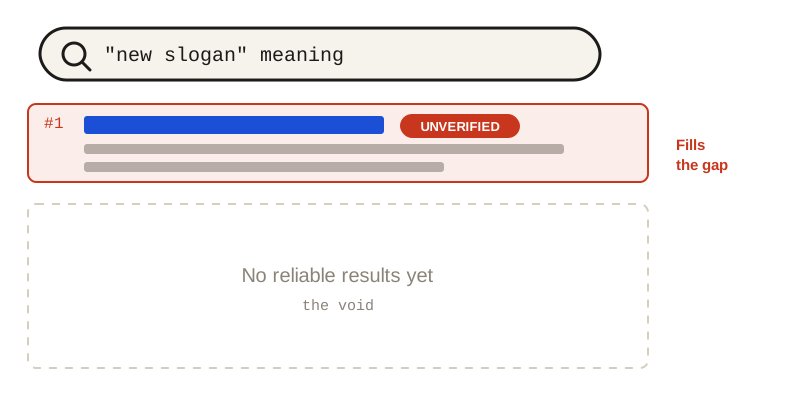
Michael Golebiewski and danah boyd of the Data & Society institute call a search query like that a “data void” because little if any trustworthy content is returned. Ranking systems can only sort what’s there, so when the shelf is nearly empty, almost anything placed on it will rise to the top.
How voids are used
Voids open most often around breaking news, new slogans and obscure terms. In the first hours after an event (before newsrooms fact-check it), partisan blogs and coordinated accounts can publish pages built around the exact phrases people are about to search for. Some groups even invent a term (“Google it!”), promote it and wait for curious users to look it up.
Filling the gap
Responses come from everywhere. News organizations publish short, fast explainers so accurate pages exist early on. Search engines have added notices saying results for a rapidly changing topic may not yet be reliable. Educators teach lateral reading: leaving a page to see what other sources say about it before trusting it.
Why it matters
For students of politics and media, SEO isn’t a marketing footnote. It’s where technology, journalism and democratic participation meet. Understanding how results are ranked (and where they can go wrong) is part of understanding how citizens learn about the world.